

You don’t need much to tell a good story if you’ve got a clear vision, a solid cast of characters, and an excellent central theme. For the 2014 anime, Riddle Story of Devil, all you need is twelve episodes.
Riddle Story of Devil flew under most people’s radars back in 2014, and that isn’t wholly surprising. It’s a short show, which means it’s highly bingeable, but only if you caught it during the miniscule span of time it possessed any form of internet relevance. Nowadays, the show is available in its entirety through FUNimation. The core concept of the show is also, at first glance, a bit cliched and well-worn. It grows to much greater heights in the span of those dozen episodes, but it can seem simple to start.
So, what is the conceit of the show? In essence, twelve seemingly ordinary high school girls have all been summoned from their daily lives to attend the prestigious Miyojo Academy. Together, the girls form a small group known as Class Black. However, the class is not your typical high school class, and the twelve girls are not your average high schoolers.
Each girl is an assassin, and the purpose of Class Black is to eliminate the thirteenth student of the class, Haru Ichinose. Whoever can kill Haru is the winner of Class Black, and they receive whatever reward their heart desires. Until Haru is killed, the thirteen students will continue to act just like regular schoolgirls.
Each girl is paired up with a roommate, and Haru is assigned to Tokaku Azuma, the protagonist of the show. Tokaku is an aloof, distant girl who finds the very idea of Class Black distasteful. She hails from the infamous Azuma clan of assassins, and she possesses a very cynical world view. This world view immediately comes into conflict with her new roommate’s sunny disposition.
Imagine the most impossibly naïve and cheerful girl you can think of, then multiple that by five. Chances are that your imagination has still fallen short of Haru Ichinose. Haru is a bundle of sunshine, constantly radiating joy to everyone around her. Even knowing that every other student is eventually going to try and claim her life, Haru meticulously crafts cute cellphone straps for each girl, gifting them out. With a full smile on her face, Haru is convinced everyone can be friends instead of enemies.
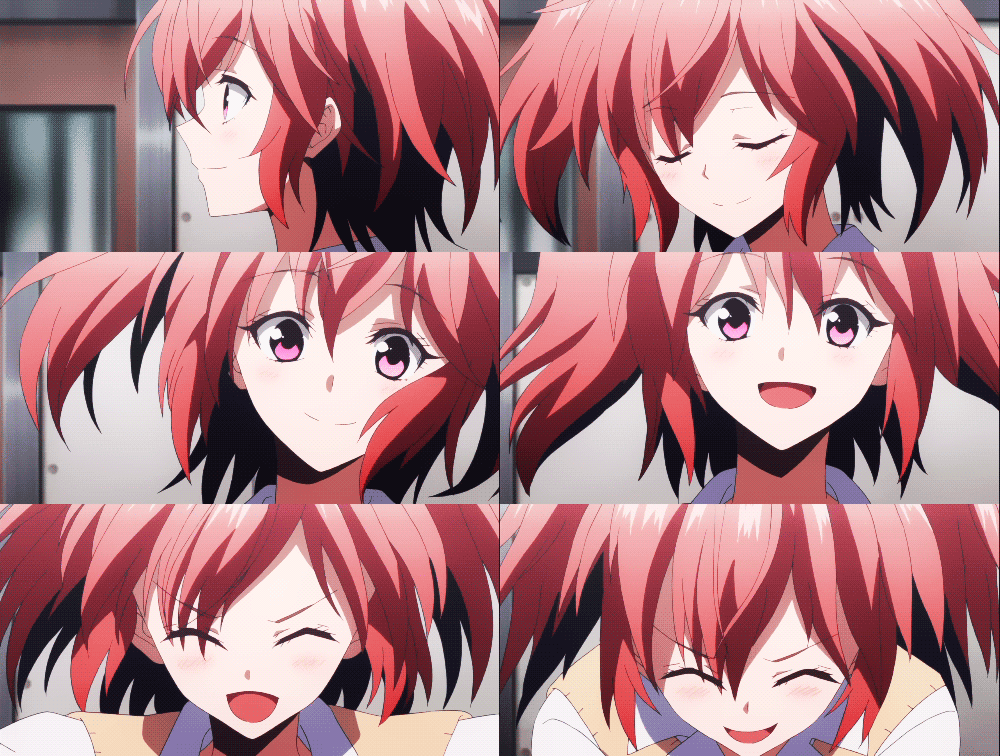
The thing is, Haru isn’t a fool. She knows that not everyone sees the world the same way that she does. She knows that darkness lurks in the world and in the hearts of others, and she’s experienced extremely traumatic personal loss in her own life. She’s been targeted by killers and criminals her whole life, and everyone around her has died so that she could keep living. Her parents. Her younger sister and older brother. Her extended family. The owners of the orphanage she was sheltered in. They’ve all died to protect her.
It’s why Haru smiles, and why she continues to fight for a brighter future. She summarizes her philosophy on life (and, eventually, the theme of the entire show) by saying that she believes “that the world is full of forgiveness”. She elaborates by adding that “in my mind, being alive means that you’ve been forgiven”. Haru recognizes that her loved ones didn’t waste their lives and die pitifully. They loved Haru so dearly that they were wholeheartedly willing to give her the chance to keep on living at the cost of their own future. In a sense, they “forgave” her for necessitating the sacrifice in the first place by returning their love and giving Haru her future.
This is an incredible difficult concept for Tokaku to grasp, and she flat out ignores Haru’s cheerful ideology for the first several episodes of the show. Tokaku has been raised as an assassin since birth, taught to have an emotionless view of the world. Her mother, a gentle soul, died shortly after childbirth, and her aunt (a defector from the assassin clan), was murdered while trying to smuggle Tokaku to a life of peace and safety.
Strangely, though, Tokaku finds herself unable to kill. The weight of her family name has carried her forward, alongside her exceedingly excellent hand-to-hand combat expertise and firearm skills. Yet, she’s never claimed a life. One of the last things her aunt ever did before dying was show Tokaku her mother’s grave. There, her aunt told her that “whenever you think of killing, you won’t be able to, because your mother will be watching”.
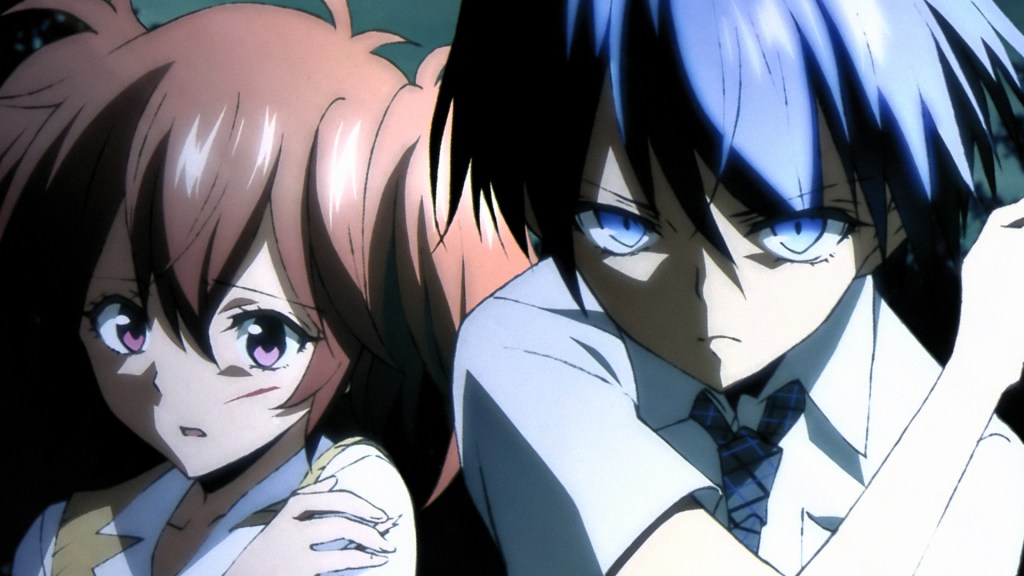
The weight of her aunt’s words and the overbearing presence of her mother’s will has hung over Tokaku for years, preventing her from ever taking a life. She deeply resents the sense of guilt she can’t fully wrap her head around, and views Haru’s past trauma as common ground for the two girls. Instead of Haru’s positive outlook, Tokaku believes the two of them are cursed, doomed to be suffocated under the words and actions of the past.
But, that common ground is enough of a link for Tokaku to decide to throw Class Black’s reward to the side and ally herself with Haru. Even she isn’t one-hundred percent certain what sways her to the ebullient Haru’s team, but she sticks to her decision. Twelve versus one has now become eleven versus two.
Through the next several episodes, Haru’s interactions with the remaining Class Black students begins to influence them. Her optimism never falters, and her profession of the joy in the world never misses a beat. Everyone else in the class is a murderer of some kind, but even the most hardened among them cannot spurn Haru’s sunshine forever. Nor are the other students as one-dimensional as they appear at first glance.
Bookish student Kouko Kaminaga is one of the first to spring her trap on Haru, and when Tokaku intercepts and begins to put Kouko on the back foot, she starts to break down. She, similarly to Tokaku, was raised as an assassin from birth, but never desired to kill. After accidentally murdering her own mother figure in a botched explosion, Kouko has wanted nothing more than to leave the assassin world behind, and she saw Class Black as her out.
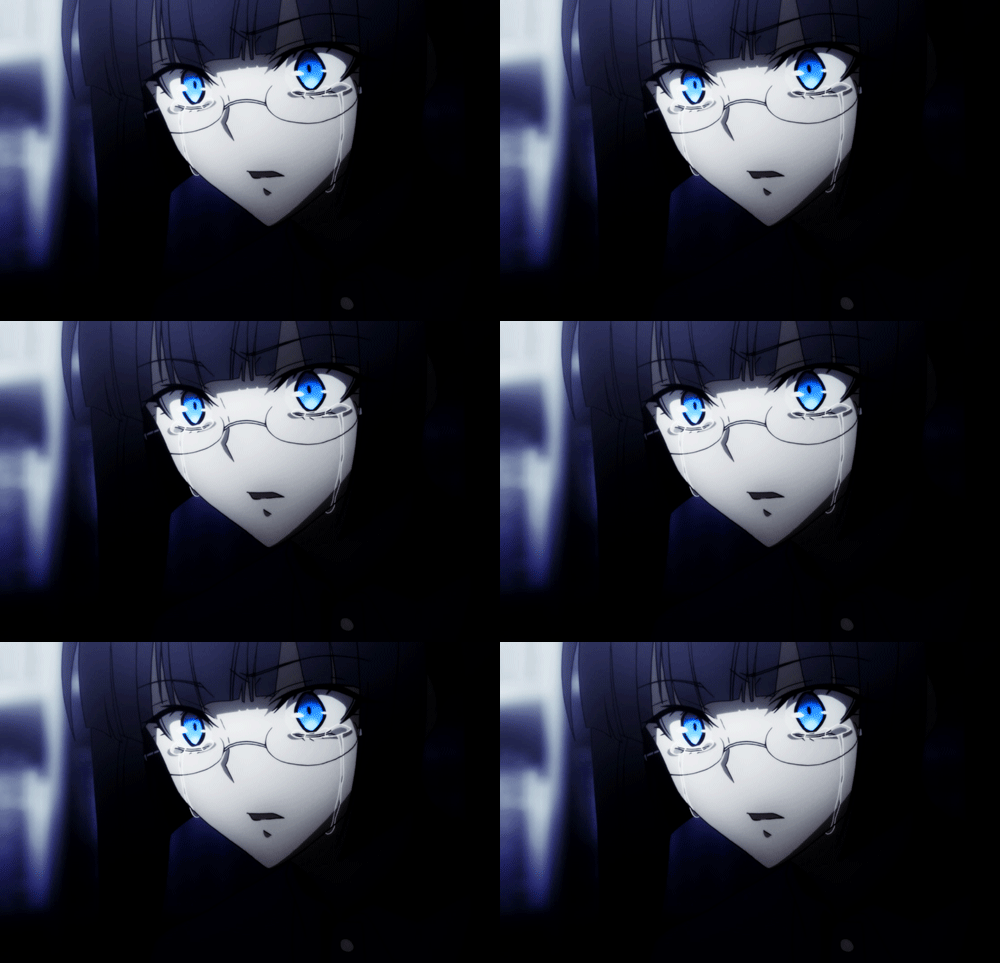
Rightfully so, Tokaku calls her out on the hypocrisy of trying to commit one more murder just to not have to kill again. It’s surprisingly biting criticism for the stoic Tokaku, who wouldn’t have batted an eye just four episodes prior. Kouko is unable to refute, is swiftly defeated, and Tokaku and Haru breathe a sigh of relief. It becomes clearer and clearer to the viewer that Tokaku’s desire to protect Haru is enhancing her best qualities and dulling her worst.
Then there is Haruki Sagae, who stages an elaborate plot involving the collapse of an entire auditorium rigging system. She’s a girl who kills for money, which funnels right towards the huge but poor family in which she is the sole provider. She is fully willing to die if it means Haru is killed and her family is supported for the rest of time. Luckily for her, she and the protagonists survive the collapse under a toppled pillar. Thoroughly defeated, Haruki braces for death, but is instead met by an offer of peace from Haru. Haru reiterates her “living means you’ve been forgiven” mantra, and a confused but gracious Haruki accepts.
Chitaru Namatame and Hitsugi Kirigaya are in a class of their own when it comes to a tragic tale of loss and forgiveness. Hitsugi has spent the majority of her life as a remorseless serial killer, and Chitaru as a bodyguard willing to do whatever it takes to keep her master safe. When Hitsugi manages to kill the daughter of Chitaru’s master, Chitaru swears that justice will be meted out. Hitsugi’s serial killer persona is shrouded in mystery, so Chitaru enrolls in Class Black with the goal of discovering and silencing her.
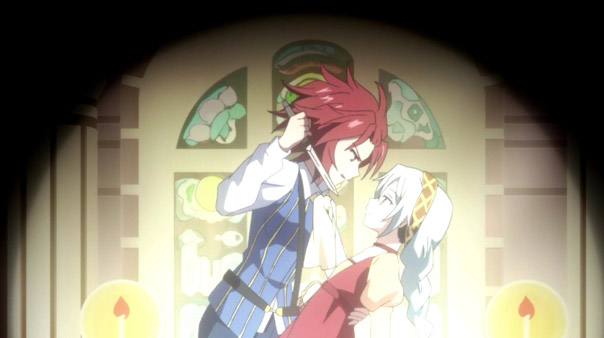
Under innocuous circumstances, the two meet and become dear friends, ending up as roommates. As the months of the school year progress, the two grow increasingly closer to each other, and inevitably, their shared secrets are revealed. Hitsugi, grieved by the loss she’s caused her newfound friend, swears off violence in hopes of staying with Chitaru. Chitaru, distraught over Hitsugi’s revelation, finds herself unable to steel her resolve. Chitaru forgives Hitsugi of the murder, and Hitsugi, in turn, forgives Chitaru for her noble mission. The two are willing to die if it means being together in the afterlife.
One of the stranger students of Miyojo Academy is Mahiru Banba, a shy loner who stays perpetually withdrawn. She has good reason for being so painfully afraid of the world. As a young child, she was forced into child slavery and physically abused and tormented. After years of suffering, she snapped, brutally murdered her torturers, and escaped. Repression of the traumatic incident caused a split personality to form: the violent, frenetic, fiercely protective Shinya Banba.
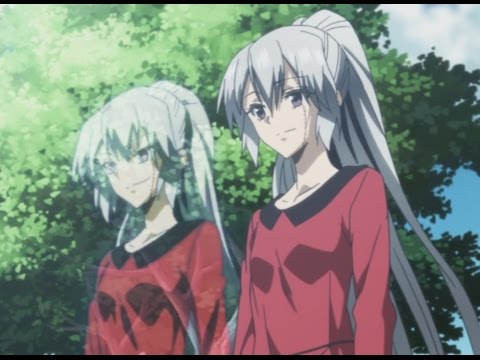
Mahiru has spent years of her life hiding in the shadows, using Shinya as a shield from the world she refuses to interact with. Over the course of the school year, she grows to genuinely enjoy spending time with her fellow classmates, and after being soundly defeated by Tokaku and Haru, she faces her strongest reality check. The horrific past she endured is behind her, and all she’s running from now is the ghostly nightmares she herself is giving power to. Putting it all behind her, Mahiru forgives both Shinya (for trying to keep her safe for so long) and the world itself, choosing for herself to see the beauty in the light.
Little by little, Haru’s compassion and warm smile change the hearts of the people around her. Haru helps Suzu Shuto throw the grieving process of her lost lover, and reaffirm her desire to keep living for her own future. Haru’s determination forces the spoiled heiress Sumireko Hanabusa to reexamine her own physical disability and not let it define her. Even the manipulatively scheming main villain, Nio Hashiri, is moved by the sacrifices Haru is willing to make to fight to keep living life. When Nio pulls through after a grievous wound in the final battle, she repeats Haru’s “living is forgiveness” ideology, genuinely seeming to look forward to her new lease on life.
And, above all, Tokaku herself grows as a person vicariously through these other girls and their character development. All of it is because of Haru.
After a particularly brutal beating at the hands of one Isuke Inukai, Tokaku is left bloody, broken, and hazy-minded. In her delirious state, she images the spirit of her mother rising from the grave to curse her for pursuing the path of an assassin. Tokaku braces for the worst, only for her mother’s spirit to embrace her daughter lovingly and gently. Finally, after so many years, the truth is revealed to Tokaku.
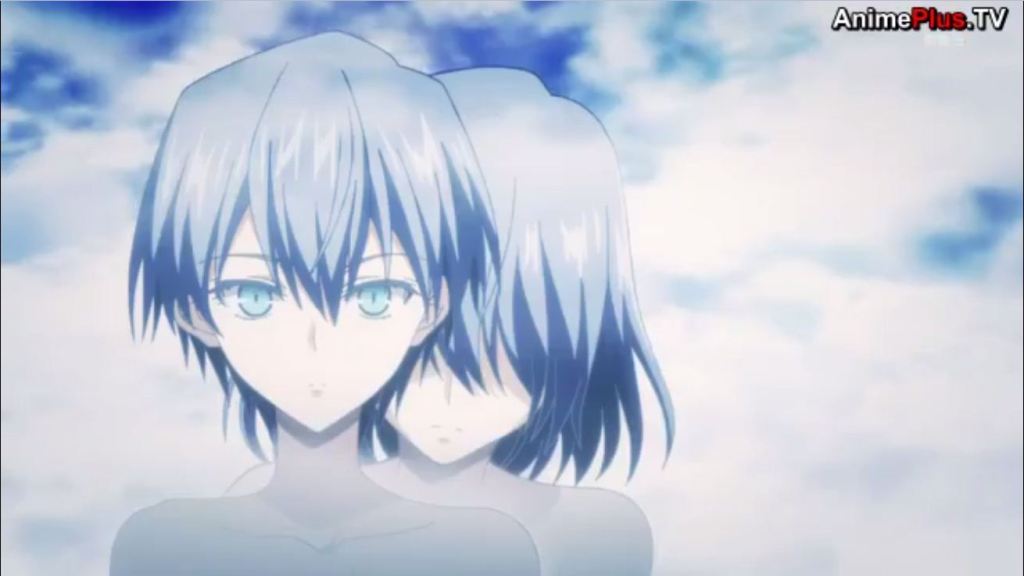
Her mother’s dying wish wasn’t trying to limit Tokaku, or hold her back. She wasn’t trying to keep her from fighting to protect the ones she loves, but to keep her from becoming, in essence, who she almost is. Tokaku is balancing on the precipice of becoming a coldhearted killer, or a strong-willed defender. Her mother and aunt were trying to spare her from pain and protect her from casting her life into darkness.
In that moment, Tokaku lets go of the demons haunting her heart, and forgives her mother’s spirit for trying to keep her out of the dark. She, in turn, asks for forgiveness back, for misunderstanding her mother’s wish for so long. She steps back from the precipice of darkness and into the light. She won’t become an assassin, but she will do anything to keep Haru safe.
There’s an extremely interesting (and at first, seemingly unimportant) framing device for Riddle Story of Devil. Tokaku is a student of the enigmatic professor Kaiba, who has an infatuation with riddles. At the start of every episode, he asks a riddle of Tokaku, demanding an answer by the episode’s end. Indeed, it is the very question of “the world is full of _______” that is the focus riddle of both the first and last episode of the show.
The riddles frustrate Tokaku for a majority of the show, and though they have little bearing on the plot, she is unable to fully get them out of her head. Her answers lean consistently darker and cynical, as compared to Haru when she tries to provide a few suggestions. At her wits end, Tokaku finally confronts Kaiba at the reason behind the riddles, and what the real answers are. His response stuns her.
“There are no right or wrong answers, Tokaku. It’s what you and the people around you make of the world that provides the answer. Your own answer.”
Tokaku from episode one would have scoffed at the idea. Tokaku from episode eleven knows differently. She has her own answer, and that answer is this: she loves Haru, and she’ll do anything to keep her safe.
A final twist in the show threatens to tear everything apart. The Miyojo Academy headmaster reveals that Haru descends from a family line, wherein the women attain a specific genetic code that alters their pheromones. Those pheromones, in turn, subtly influence the people around them into doing whatever they want, whether that be laying down their lives in service, or offering to protect them from eleven other assassins in a school-based killing game.
Haru adamantly refutes the claim, but as she can think of no way to objectively prove the headmaster wrong, she sinks into a depression. Tokaku feels intensely betrayed.
If the headmaster’s claim is right, then every joyous thing Haru has clung to throughout her life is shattered. If her power is real, then her parents, siblings, and foster care family didn’t willing die so that she could reach her future. They were nothing but slaves, bound to Haru’s will when she herself was unaware of the effect. Her relationship with Tokaku too, thusly, must be nothing but a fabricated reality.
As Haru falls deeper into despair for the first time in the series, Tokaku wrestles with her own feelings on the matter. Being together with Haru truly did bring her joy, and she knows she’s changed for the better thanks to her interactions with her, but if their entire relationship is a lie, then what of the character growth Tokaku went through? Is that a lie too? Is she genuinely nothing more than a brooding assassin, destined to become what her mother fought to prevent?
After much deliberation, and some final words of affirmation from Kaiba on the nature of finding one’s own answer, Tokaku reaches a decision. She is going to continue to trust in, continue to love, Haru. The only way to do that is to prove that Haru’s power doesn’t exist, thus confirming that Haru’s love and forgiveness mentality is real, that all those who died to keep her safe did so of their own free will and love. The only way to do THAT is to commit an act so thoroughly against Haru’s safety that her alleged influencing power would never allow it.
Tokaku, for her sake and for Haru’s, swears to kill Haru.

At the culmination of an extremely emotional confrontation, Tokaku does just that. Haru runs herself through on Tokaku’s sword, and slips away into the eternal abyss in Tokaku’s arms. In her final moments, she thanks Tokaku for proving the truth of love. She forgives Tokaku for what she had to do, even as the normally stoic girl breaks down into sobs. The screen fades to black, as Tokaku is declared the winner of Class Black.
This would be one heck of an ending as is, but Riddle Story of Devil isn’t done yet.
Haru lives, through a combination of prior intensive surgeries granting her additional resistance to wounds and blood loss, and also potentially Tokaku’s own wish. As stated at the beginning of the show, the winner of Class Black receives any reward that their heart desires. As Haru is taken away in an ambulance after being stabbed, Tokaku laments with grief how her one wish can now no longer come true. The Miyojo headmaster is beside her as she says this, and it most definitely is not a stretch to imagine that Tokaku’s wish was for Haru to be alive and by her side forever, and that the headmaster granted that wish.
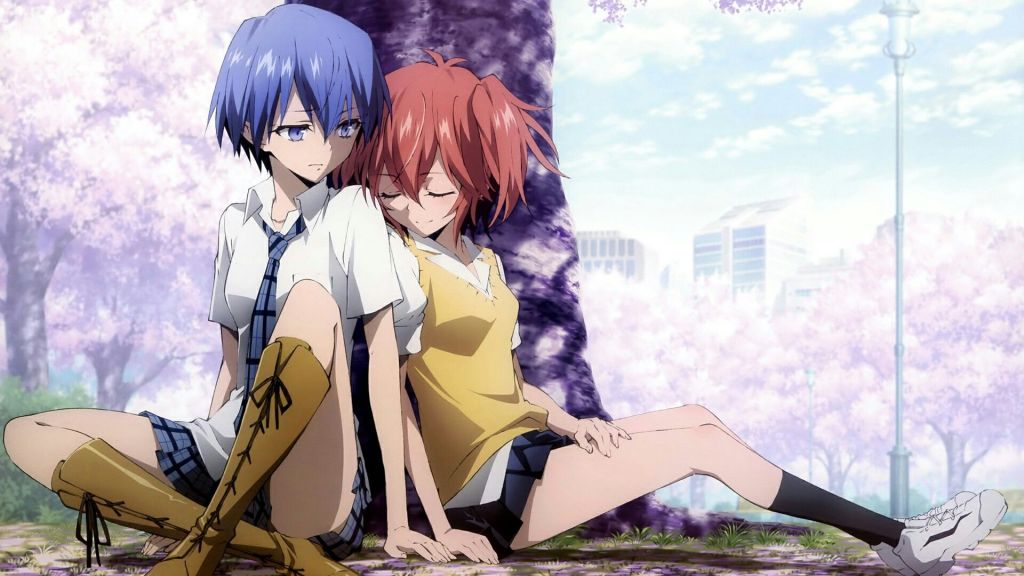
Regardless, Haru lives through her Class Black ordeal, and sticking to her mantra to the letter, she does not let any of the setbacks or memories hold her down. She walks out into the bright sunlight with a full smile on her face. Sliding her arm around Tokaku, the two walk off into their bright futures. No more violence, no more killing. Just two girls destined for each other, facing the world head-on with smiles on their faces.
In fact, every single character pulls through in the end. Isn’t that ironic, in a show about assassins and a killing game, that not a single character perishes? It’s rather poetic, and extraordinarily indicative of the theme of the show. Making mistakes is a part of life, but the ability to forgive and be forgive is a sign of true mercy and love. Being alive means you’ve been forgiven, and being forgiven means you’re alive. Go out and live!
Call me a starry-eyed optimist, but how can you not smile at such a cheerfully uplifting ending as that?
But hey, that’s just my opinion!
 The Contrarian Corner