

As a massive fan of the Xenoblade series, I could take a million more sequels and still be happy. Does that mean that I actually expected there to be more sequels after the second game? Not particularly, and certainly not this soon. Still, as soon as I saw an anime man with a sword and a British accent during February’s Nintendo Direct that revealed Xenoblade Chronicles 3, I knew it was going to be the announcement of the next entry in my favorite JRPG series of all time.
This marks the second game made for the Switch, and also now means that someone interested in Xenoblade can play all three entries in the trilogy on the Switch, thanks to the definitive edition port of the original. Of course, Xenoblade Chronicles X is still locked to the Wii U, which is basically a war crime, but I digress.
From the very first trailer, it was clear that Xenoblade Chronicles 3 was going to be a sort of “course correct” for the series after a few of the missteps in the second installment (for starters, just look at the game’s character designs compared to, say, Pyra). And, having practically 100% completed the game myself, I can confirm that it is, indeed, incredible. Hopefully the following review will convince you of the same thing. If I can convert yet another person into a Xenoblade fanatic, then my life is complete!
Let’s get this review under way, shall we?
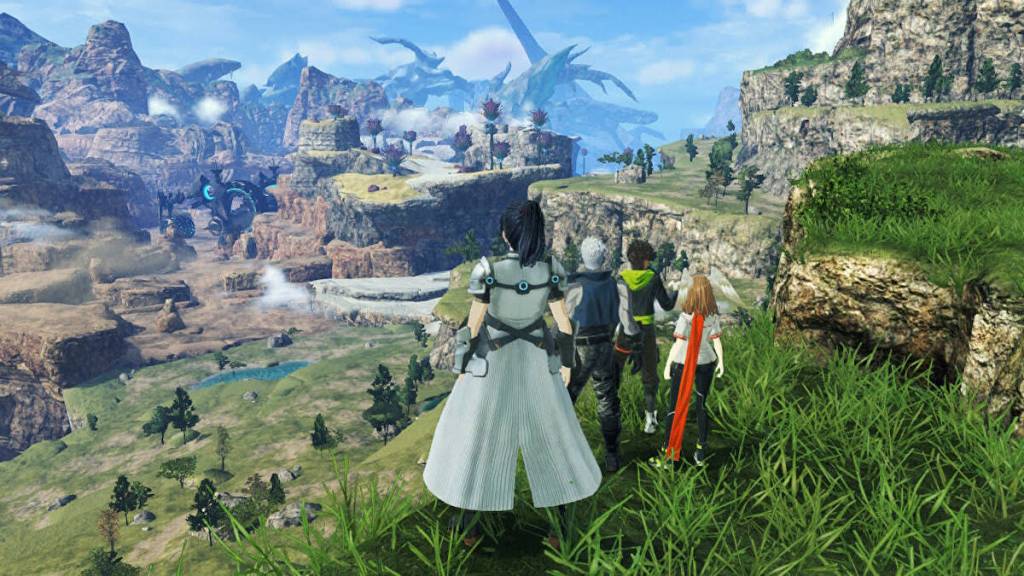
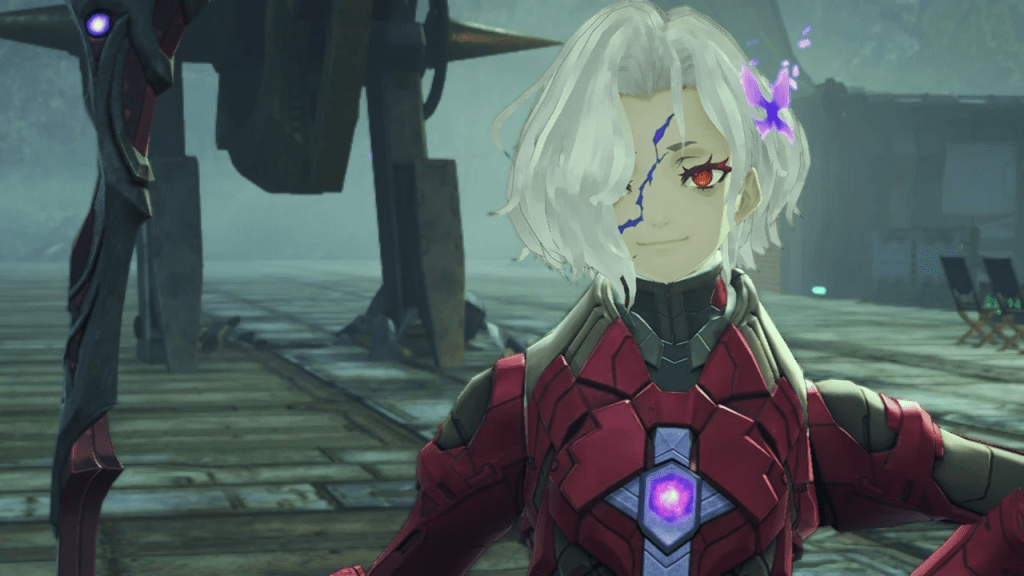
Visually, this game represents a bridge of sorts between the art style of the original game and the art style of the sequel (a funny connection, considering the plot of the game). Monolith Soft continuously proves that they are the masters of squeezing a Nintendo system for everything its worth, because this game is gorgeous on a visual level. From the wonderful character designs to the beautiful landscapes, this game excels visually. It also runs really well, with very minimal performance issues or slowdown. This is surprising, considering how much the previous game struggled in this department.
I HAVE to take a moment here to commend the game’s character animation. I’ve spent a fair bit of time watching and re-watching the cutscenes in this game, and every time I notice some small little detail that shows the love and care Monolith Soft put into crafting these characters. Like, seriously, the character animation in this game is some of the best work I’ve ever seen in a videogame. Whether it’s the cat-eared protagonist showing their emotions through their expressive ears, the extremely well-choreographed action scenes, one specific character’s emotional breakdown, or the subtle eye and lip movement present in nearly every scene, Xenoblade Chronicles 3 is practically perfect in this regard.

Xenoblade games have never been strangers to awesome and unique voice acting, and this trilogy ender is no exception. In fact, this game’s voice acting might genuinely be the best in the series. Adam Howden is amazing as Shulk, and Skye Bennett is equally amazing as Pyra/Mythra, but there just isn’t a single weak performance in this bunch. Noah/N, Mio/M, Eunie, Taion, Fiona, Shania, and so many more put so much energy and passion into every single line of dialogue that it’s almost jaw-dropping. This is one of the best English dubs I’ve ever heard.
What’s even more impressive is the fact that nearly 80% of this game’s cast as NEVER acted in any other voice role before. It’s baffling that Monolith Soft would bank it all on untested actors, and it’s mind-blowing that it worked out so well for them. Genuinely, it’s kind of inspiring, as a voice actor hobbyist, to see newcomers bring this much talent and perfection to the table.
And, to the surprise of absolutely no one, the soundtrack in this game is really good. Par for the course for a Xenoblade game, perhaps, but still noteworthy. A good soundtrack really brings a game together, and this game’s track list is bursting at the seams with bangers, particularly in the battle theme department (like, no joke, this game has over 16 unique battle themes). If you’ve got the inclination, the tracks I’d recommend giving a listen to are KALEIDOSCOPIC CORE, THE CITY, and WORDS THAT NEVER REACHED YOU.
(Before we move on, this is the best time to mention that this game had an unfortunate amount of minor bugs and glitches when it launched, and several still persist to this day. A few small quests were impossible to complete because enemies did not drop the requisite required item, dialogue prompts would skip, audio cues would refuse to play in a few key scenes, and the game had a tendency to crash while skip travelling. These are minor annoyances true, but they do add up a bit. Most are patched by now.)
So, onto gameplay!
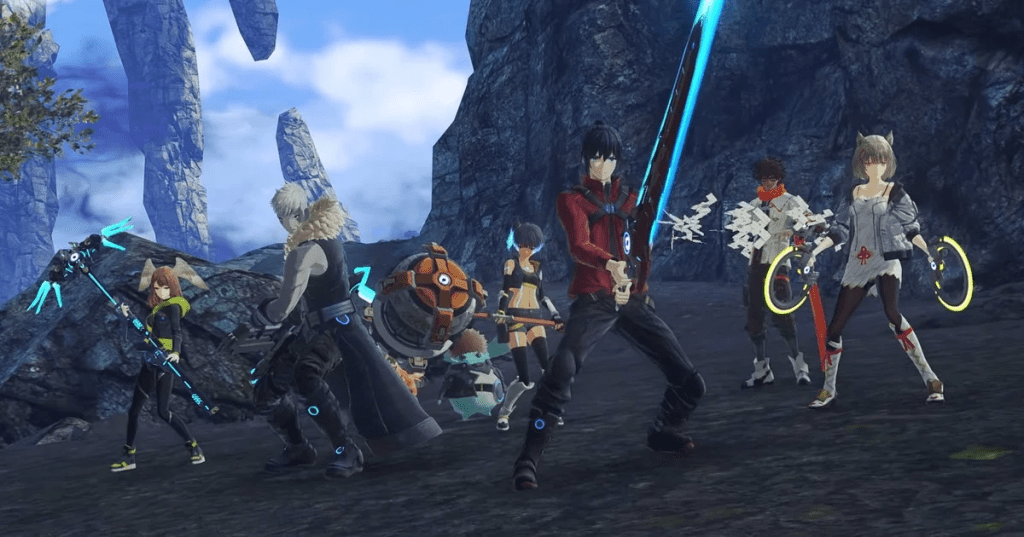
Like every other Xenoblade game, this game is split between exploration and combat. The exploration in this game, I’ll admit, is a little hit or miss. I certainly appreciate the wide-open spaces being filled with enemies, collectables, husks to send off, treasure containers, and other assorted secrets. However, visually, there isn’t much new here to see in the world. While still gorgeous and engaging, the world is mostly populated with generic caves, grasslands, deserts, and oceans. Granted, it had steep competition, but the exploration can’t compare to the world design of the original game (and neither hold a candle to Xenoblade X).
(Also, I don’t know where else to mention this, but you get a boat at a certain point, and you can drive the boat around an ocean. The boat controls are AWFUL. Like, horrifically bad.)
A big part of this game involves Heroes. See, your main party is made up of six permanent members, but you can add in a seventh hero, after you’ve recruited them. These heroes could be an old friend of a party member, an enemy commander convinced to join your side, or a wandering traveler. You’ve got the suicidally reckless warrior Ashera, the reserved and tactical Isurd, the mouthy brawler Ghondor, the stoic and mysterious mercenary Gray, and so many more. The heroes are diverse and distinct, and each bring their own skills and classes to the party.
Which, logically, brings me to classes. Classes are both a highlight of this game, and its single biggest downfall. There are over twenty classes in the game, you can switch between classes at any time, and upgrading a class allows you to mix-and-match their skills and arts. With enough time (and brain power) you can create absolute monsters of battle with your party members by utilizing the class changing system to its fullest. Even if you don’t, though, each class is still fun to play on its own.
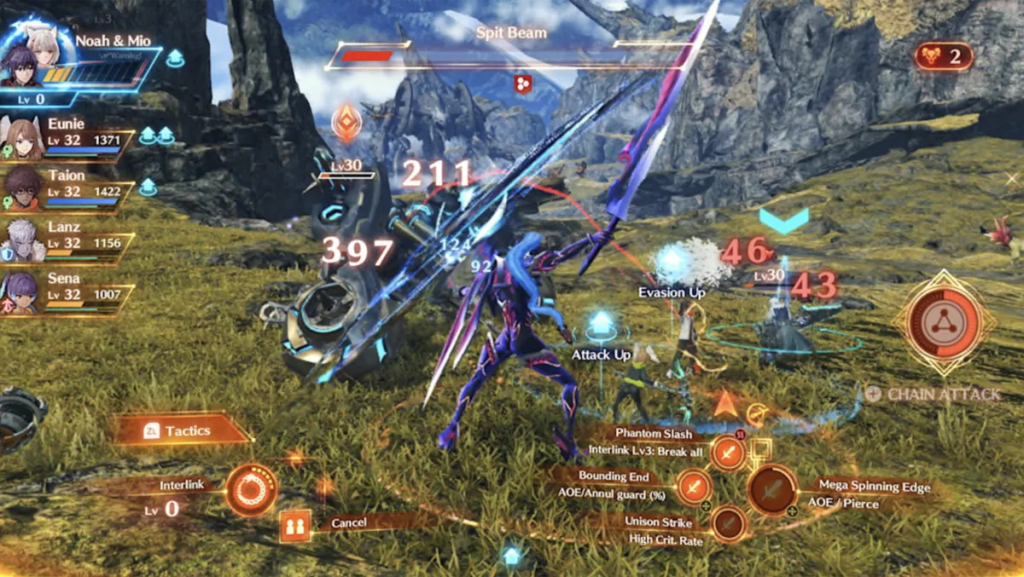
The downside, though, is that your party members are severally lacking in uniqueness during combat. Every character can be every class, and no one differs from one another within the same class. The game actively encourages you to switch classes regularly, so it isn’t long before everyone has been every class, and knows every skill. You end up with a homogenous group of units that have minimal distinction, and it drags down the experience.
This doesn’t mean that combat isn’t fun. It is, even if many of the battles involve going through similar motions. The classes and their various distinct traits keep battles fresh through the whole game. Your whole team synergizes really well, and taking down big baddies is always a blast. Chain attacks are beefier than ever before, and add a new level of strategy and excitement. Your party members can also briefly transform a few times each fight, opening up new attacks and combos.
Really, the biggest problem with the game is that it has such a huge lack of replayability. A first playthrough of Xenoblade Chronicles 3 is a thing of wonder. A subsequent playthrough is an exercise in patience. You use the same classes, with the same skills, in the same way, because that’s how the game is designed. Everybody NEEDS to be every class. What once seemed to be a system designed to encourage customizability and personal strategy is revealed to be a system that enforces monotony.
I have to stress, you likely won’t notice this on a first playthrough. But the more I thought about it, the more I realized I don’t feel particularly compelled to replay this game. Maybe in a few years, but even then…I’m unsure. This stands in stark contrast to Xenoblade Chronicles, which I literally replayed immediately, and Xenoblade Chronicles 2, which I replayed less than a year later. I enjoyed this first playthrough of this game a lot, but I honestly don’t know if I can handle the same old motions again and again on repeat adventures.
But enough moaning and groaning, let’s move onto something that I really did enjoy: the story and characters.

Xenoblade Chronicles 3 presents the most dire world we’ve seen yet in this trilogy. Living on the body of a dead god is pretty awesome, and travelling the cloud sea on the backs of titans is super neat. Being stuck in an endless loop of death and fighting where you are born and bred for battle, live only ten years (at a maximum), and are cursed to repeat this loop for all eternity, waging a meaningless war? Yeah, it sucks for everyone involved…except, of course, for Moebius, the evil conglomerate pulling the strings behind the scenes.
The core cast is comprised of three characters from each of the two armies of the war, Keves and Agnus. From Keves we have Noah, Eunie, and Lanz, and then from Agnus we have Mio, Taion, and Sena. These six characters, at first enemies, are united under a common banner when gifted the power of Ouroboros, and tasked with defeating Moebius and returning the world to the way its supposed to be. It’s a solid enough hook on its own, and gives everyone involved in the story a reason for pursuing a common goal.
When the game really shines, though, is when it explores the deeper concepts at root in the themes of tis adventure. JRPGs are no strangers to waxing philosophical about anything and everything, but I’ve never seen it handled quite so thoroughly and delicately as it is in this game. Throughout the quest, the characters frequently stop to discuss the nature of war, the point of their existence, the purpose of life, and the weight of their shortened lives. Each of these discussions are treated seriously, without the typical JRPG goofy shenanigans or fanservice.
Because of this, the main cast shines brilliantly in this game. I might have overwhelming nostalgia for the original Xenoblade, but I’m not blind. This game definitely has the strongest main party out of the trilogy. Every character gets a chance to shine, whether that be through a poignant one-on-one conversation, emotionally resonant climactic scene, crazy hype battle against one of the game’s villains, or anything else in between. Every main party member also has their own Side Story to complete, furthering their character growth.
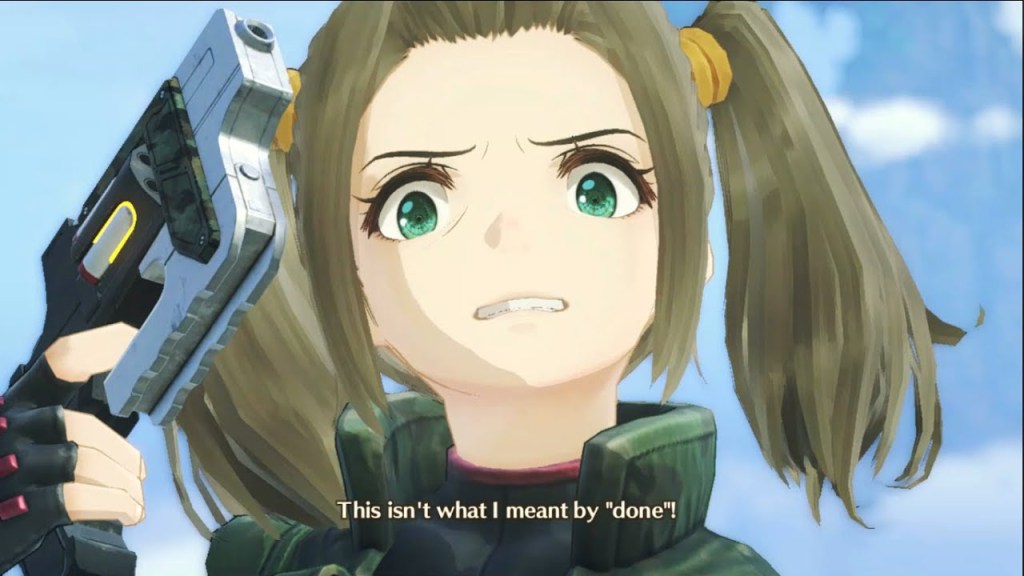
Really, there aren’t any characters shortchanged by the writing and pacing of this game (except, admittedly, for Sena, poor girl), and this extends to people outside of the core cast. Supporting cast members like Ethel, Monica, and Ghondor get their own character arcs and times in the spotlight. Optional Hero characters like Ashera and Fiona have compelling quests tied to their contribution to the game’s central themes. Even the lowliest of NPCs harken back to the glory days of the original Xenoblade, with their own backstories and memorable moments of growth.
Now, to some, the villains of this game are hit-or-miss. While I can see those arguments, I’m actually a huge fan of them. I think it was a breath of fresh air to use such a huge group of baddies as the core antagonists instead of just one or two central foes. What this allows is for each individual villain to be unique, and the developers at Monolith Soft try something new with each one. Some of the minor Moebius mooks are forgettable, sure, but for every Consul L and H, we get X, Irma, N, and Shania. Oh goodness, Shania.
A part of what makes the story of this game so compelling is the side content. Not only is there a lot of it (and I mean a LOT of it), but the side content is consistently high quality, in terms of both writing and also production value. There are Side Stories (as previously mentioned), Hero Quests, and also basic colony side quests. These quests are packed to the brim with twists and turns, surprising depth, and plenty of fully-voiced and animated cutscenes. This game went above and beyond in delivering stellar optional content to the player.
Really, this game is just awesome. As I mentioned before, it’s single biggest flaw is its soul-crushing lack of replayability, but I beg of you, don’t let that deter you from playing this near-masterpiece. Not many JRPGs are as good as Xenoblade Chronicles 3 (and for that matter, not many games in general are), and it would be a shame to miss this incredible and unforgettable conclusion to any all-time-classic trilogy.
I’m really feeling it!
9/10
But hey, that’s just my opinion!
 The Contrarian Corner