

Once or twice in the history of this blog, I believe I’ve mentioned my love of minor/side characters in entertainment media. Protagonists, antagonists, random side characters…it doesn’t really matter. I’ve always had a bit of an undefinable infatuation with bit players in larger stories.
Perhaps it has something to do with possibility or potential. Many side characters only pop up a few times during a story, but obviously they are off doing their own thing at other times, right? They’ve got lives and histories that are all their own, and it’s basically up to your own imagination as to what might be going on, because given their status as minor characters, much of what makes them tick isn’t shown.
Well, take my love of minor characters and my love of villains, and then mash them together. What do you get? A recipe for a certain brand of character love and appreciation that might only be enjoyed so fiercely by me and me alone. I certainly hope that others out there share my adoration for this niche of characters though!
Think of something like Star Wars. It’s got big baddies like Darth Vader and the Emperor, and they are both great in their own ways. But…how awesome is Darth Maul?!? That fierce red-and-black face paint, the double-bladed lightsaber, his pseudo-theme song “Duel of the Fates”? Not to mention the incredible lightsaber duel that caps off The Phantom Menace? It’s the stuff of legends, and his character (even disregarding all the Clone Wars and Rebels stuff in recent years that has him in it) has persisted as an icon for years, despite him having less than fifteen minutes of screen time in a single movie!

I think a lot of the appeal of minor antagonists comes from the ways in which they avoid having to be beholden to the main plot or themes of a work. Let’s use that same Star Wars example. Darth Vader’s story is integral to the core of Star Wars, what with his redemption and sacrifice of saving Luke and bringing balance to the Force (never mind a certain trilogy of sequels…). I mean this in no way as a criticism of his character arc, but Darth Vader is essentially locked into a certain path in order for the story, themes, and emotional impact to work.
Darth Maul? He just has to look cool and be good at fighting, because in the grand scheme of things he’s relatively unimportant! Honestly, The Phantom Menace arguably went above-and-beyond in making Darth Maul awesome and memorable, as his role (the muscle to Darth Sidious lurking in the shadows) could’ve been handled in any which way.
Now, this isn’t to say that a minor antagonist has to be irrelevant to the plot or themes of a movie, game, show, or book. Sometimes they are pretty critical. The key is simply that they are not the main focus that the narrative is trying to present.
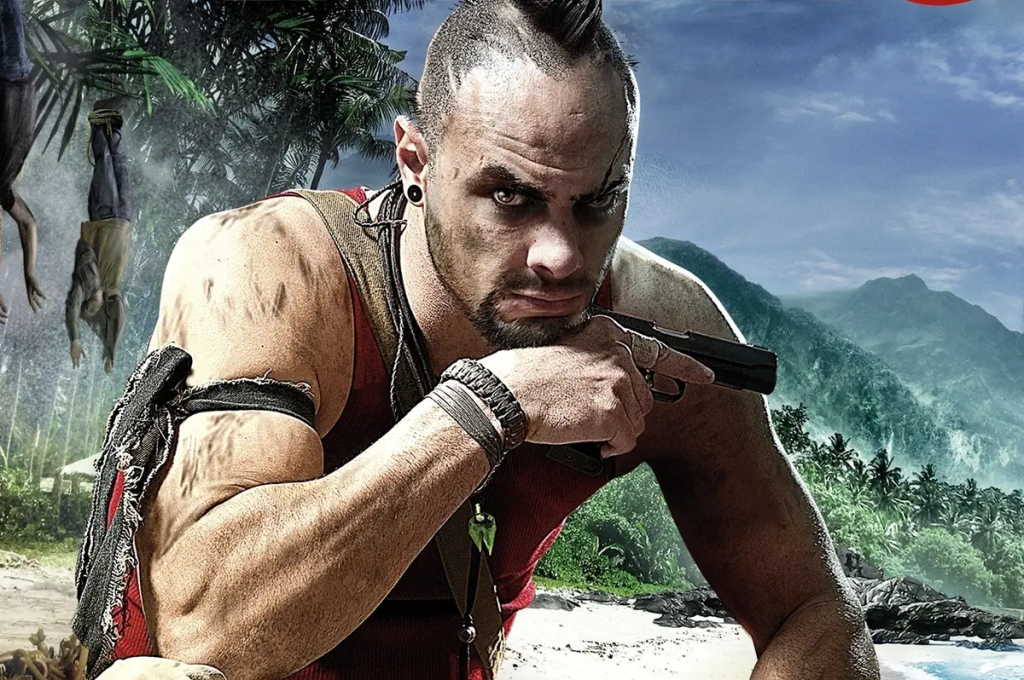
An extremely iconic example would be the character of Vaas Montenegro from Far Cry 3. Almost anyone with passing knowledge of video games knows about Vaas and his infamous “Do You Know The Definition of Insanity?” speech. His performance is iconic, his behavior and demeanor are arresting, and his impact on the culture of gaming has been immense. But, the truth is, he’s a bit player who is killed off halfway through the game, because he’s always just been a lackey to the true villain.
This all might’ve been a bit ramble-y. I apologize, but I honestly have trouble putting my love and thoughts about minor antagonists into words even just in conversation with friends and family. Maybe some part of me just likes latching onto characters who only rarely have the spotlight?
One has only to look through my past articles to see a pattern in villainous characters I love and their status as minor villains:
Torchwick and Neo (barring season nine) from RWBY, Barriss from The Clone Wars, Sinara and Ruby from Agents of S.H.I.E.L.D., Jellal from Fairy Tail, Shania from Xenoblade Chronicles 3, and much more aside! Heck, even Tory from Cobra Kai more-or-less counts given that Kreese and Silver are the real main threats of the narrative!
All of this preamble is to say that I just played through the recently released Freedom Planet 2 (the sequel to one of my all-time favorite games Freedom Planet), and it absolutely nails the role of a minor villain. Well, it and its predecessor, and they do this through the form of Syntax, the green-domed tentacled machine menace!

Syntax is introduced in the very first cutscene of the original Freedom Planet. She’s a squid-shaped artificial intelligence drone that serves as the right-hand robo-woman to the main villain, Lord Brevon. She’s mean, she’s green, and she’s exceptionally deadly. In the first cutscene alone she assists Brevon in taking over the Shuigang Palace, then she brainwashes poor Prince Dail into serving the man who just murdered his father!
After that, Syntax is always seen hanging around wherever Brevon goes. He also places her in charge of guarding key positions, which is why our main heroes first encounter Syntax when they raid the lake-bound Thermal Base six levels into the game.
In the Thermal Base, Syntax serves as both the halfway mini-boss and the end-of-level showdown. In the first, she shifts between a spider-crab-thing and a spike-shooting wallcrawler. In the second she’s in the form of a massive lava-spewing squid. Immediately, Syntax’s powers of changing her own shape and the forms of her surroundings is displayed to the player. She is the robotic queen of violent versatility.
She’s also keen to taking a page out of the GLADOS playbook. She’s not some emotionless order-following husk. Syntax has a personality all her own, and delights in tormenting our heroines as they explore the Thermal Base (luring them into traps with glee and sarcastically congratulating their progress right before dropping bombs onto them). She has legitimate agency, which is rare with these sorts of robotic AI characters, especially a minor villain like Syntax.
After helping Brevon to torture Lilac (in one of the most shockingly (no pun intended) jarring scenes I’ve ever witnessed in a video game), Syntax makes her next appearance piloting a massive two-armed spaceship during a shootout with Lilac. Despite the huge explosion of the spaceship upon winning this fight, Syntax emerges unscathed and flies away to battle another day.
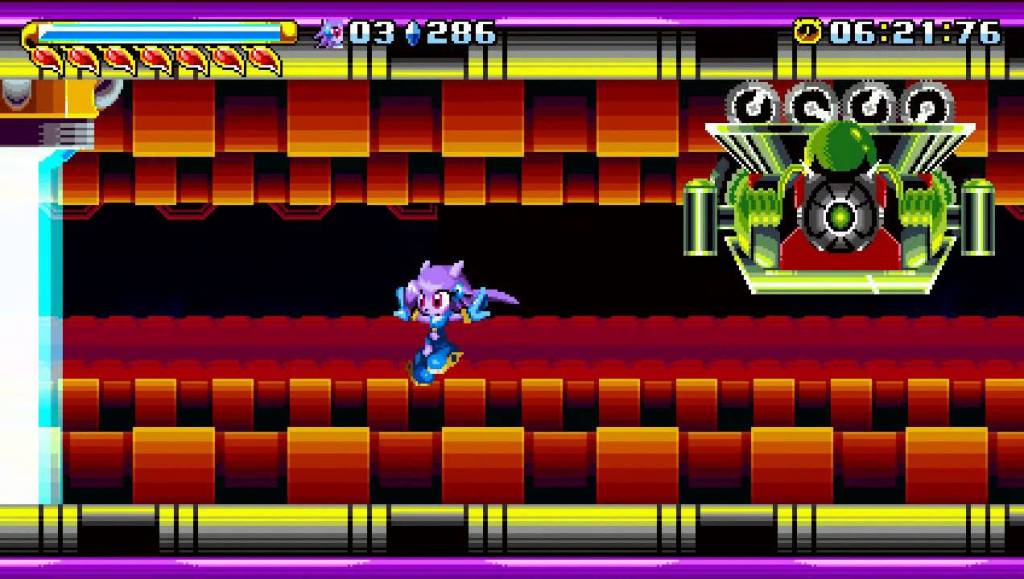
That other day ends up being two levels later, where she serves as the boss of Final Dreadnought 1, a part of the endgame gauntlet. And this battle is nuts! Syntax shifts between no less than five different forms, pulling out all the stops to put an end to our heroine’s quest! It’s a tough and hard-earned victory, and Syntax fades away into dust upon defeating her.
Any normal person would assume that Syntax is dead at this point. Truthfully, so did I. However, I’d always had an appreciation for her ever since my first playthrough. I loved her tenacity and how many showdowns you have with her. She really felt just as compelling to destroy as Brevon did, so despite having no reason to think she’d still be alive in Freedom Planet 2, I hoped she’d show up somehow anyway.
And boy howdy, does she ever!
About a third of the way through Freedom Planet 2, you find out that some of Brevon’s robots are still sneaking around in the snowy mountains outside of Shuigang, despite Brevon (who survives the previous game) having left the planet and his factory having being blown up. So, you head out in search of who could be behind the robots continued presence, and who do you find in the aptly-titled Robotic Graveyard level then Syntax herself?
And it’s not even a stretch to assume that some tiny fragment of her survived and pieced herself back together in the remnants of Brevon’s Thermal Base. In fact, she’s even kick-started the Thermal Base back into action, ramping up production on more robots to try and take over the world again. In two back-to-back levels, Syntax serves as the end-of-level showdown, and proves to be just as tenacious and multi-faceted as she was in the first game.

From there, Syntax ends up falling into the hands of another returning enemy from the first game, General Serpentine. Serpentine activates a hidden function of Syntax known as “Code Black”, a feature that allows her to interface with her surroundings and forcibly conscript the local wildlife (and the army of Freedom Planet 2 big bad, Merga) into obeying her and Serpentine’s will.
This, inevitably, leads to a crazy level wherein you battle against both the forces of Merga and Syntax/Serpentine, which then just becomes one singular brawl once Syntax’s Code Black turns the entire jungle against you. It kind of serves as a retroactive explanation for how Syntax has been able to brainwash individuals and morph into so many forms. Regardless, you battle her for a third time in a joint fight against Serpentine.
Afterwards, you take Syntax into custody, but when the stakes escalate to world-ending levels near the game’s end, you’re forced to begrudgingly team up with Serpentine to stop Merga’s world-destroying starship. Using the power of Syntax, our team of heroes makes it onto Merga’s starship and deals some crippling damage, but Serpentine pulls the rug out from under our heroes with an attempted betrayal by stealing Syntax back and activating Code Black on the starship.
Things go crazy thanks to Code Black, and it becomes a hectic dash to get through the maze of hazards and stop Serpentine from claiming the power of the deadly starship for himself. You clash with Syntax for a fourth time (once more in a double-battle with Serpentine), and you manage to blast the wily drone to bits and send Serpentine flying off into the void. Merga, meanwhile, acts from her own control center to purge Code Black from the system and take her starship back.
Any normal person would assume that finally, decisively, Syntax has been dealt with. I certainly did.
Those people, myself included, would be wrong.
In a stunning twist, right after you finally defeat what you thought was the final boss battle against Merga, and you’ve helped Merga see the error of her ways, the music cuts out ominously. A gargantuan computer screen in the background of the room clicks on, revealing Syntax’s single unblinking eye, as she lets out a single chilling line (that should be familiar to anyone with a background in IT).
“Hello World.”
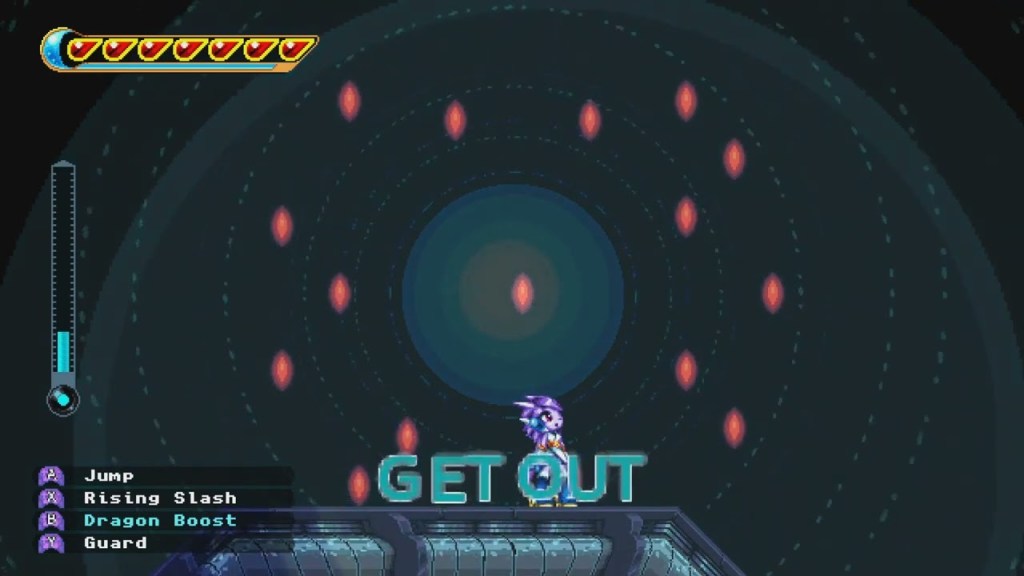
Syntax wasn’t defeated at all, nor had Merga truly purged Code Black from the starship’s interface. Syntax was merely hiding, biding her time and strength. Unleashing her full power all at once, Syntax seizes control of the starship’s systems and begins readying the main cannon for a blast that will end all life on the planet below. In a frantic hurry, our main heroines and even Merga herself rush off to stop the genocidal robot.
What follows is a level unlike any other, entitled “Weapons Core”. You fight your way through a dark and foreboding maze, all while Syntax looms in the background. If her eye lands on you, a bar on the right side of the screen will begin to charge, and if it fills Syntax will instantly kill you. All the while, she drones on “Get Out, Get Out, Get Out“, in an increasingly furious and distressed voice. The only soundtrack playing in the background is unsettling ambience. It’s some truly tense, scary stuff.
It all culminates in the true final boss battle against Syntax herself, once more in a new form thanks to the power she’s siphoned from the starship. It’s got multiple phases, super tough attacks, awesome music, and brings in all of your allies to assist. She even creates holographic clones of Brevon, using his iconic attacks from the previous game’s final boss battle. It’s a hard fought battle, for sure.
After winning, the starship begins to blow up and crash into the ocean. And yet Syntax still gets the last laugh! She manages to send a distress beacon out to Brevon (almost assuredly confirming him as the inevitable Freedom Planet 3‘s main foe), and then she uses her last gasp of power to slam into Lilac and knock her unconscious, which would have left her to die had Merga not leapt to the rescue.
In the aftermath, nothing remains of the starship, or of Syntax. Her threat has finally been ended for good…or, at least, that’s what I’d assume! But hey, I’ve been wrong twice before already!
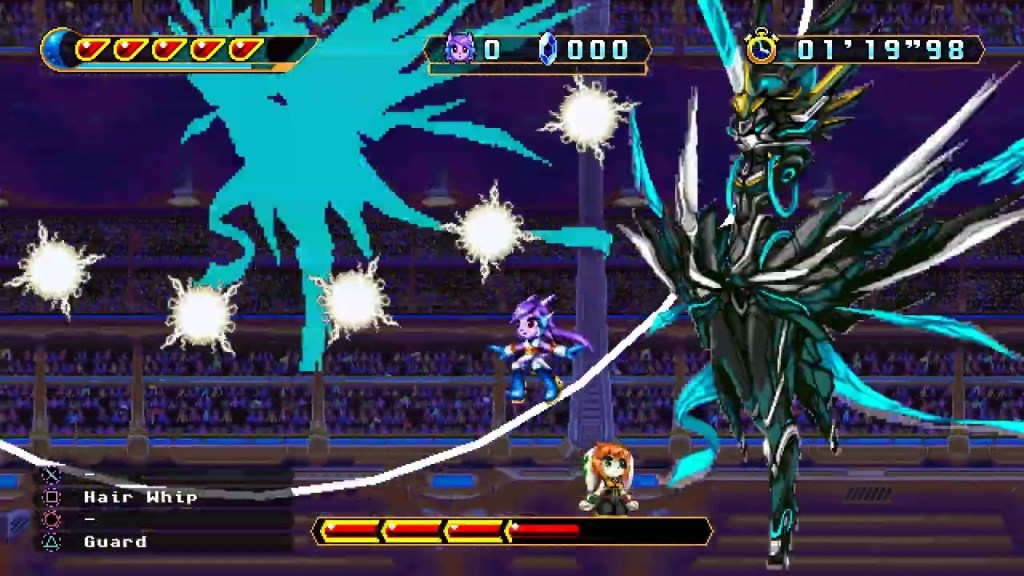
Syntax represents everything awesome about minor antagonists in entertainment media. They just has so much flexibility and versatility! Minor villains can be used for practically anything a creator could want, in order to enhance the experience of the player/reader/watcher. And, at the end of the day, if no one else is going to give them their dues, then I’ll just have to keep doing it! They’ll always hold a special place in my heart!
But hey, that’s just my opinion!
 The Contrarian Corner