

(Writing Talk is a type of short-for article centered around conversations about various aspects of writing/authorship. These aren’t usually long reads, but I think it’s fun to jot down some of my thoughts about the writing process as someone who loves the art of it all.)
In some ways, this article is going to build off of the article from last week, which talked about the tricky nature of trying to write a redemption arc for a character. Expanding on some of the points made in that article, this one will be talking about how important it is to handle character consistency when you’re writing a story, and how a strong first impression can help to define how your audience sees a character…for good and bad.
See, it can be very difficult for your audience to latch onto one of your characters if they aren’t represented in a consistent way. I brought this up when speaking about villains getting redemption arcs, but it doesn’t have to solely relate to just antagonists. If you have a protagonist who loves to be witty and make quips, but is suddenly completely serious in the next scene, before switching back to their jokey self? It’s going to feel off, and your audience is going to suffer a bit of a disconnect.
Now, there’s a few things that I DON’T mean by saying this.
First is that I’m not referring to character arcs. Part of the point of storytelling itself is characters undergoing arcs of development. You’d have a pretty boring story if your major characters started and ended the story at the same place, thematically speaking. You need to have characters take steps through personal journeys of growth, and it’s undoubtable that they will emerge from the other side a changed person. Maybe only slightly, or maybe in more major ways, but they will change.
This, in fact, despite having the word ‘change‘ in it, is true character consistency. Or, at least, it’s character consistency if you’ve written it well. If you’ve devoted the proper care, attention, and detail to crafting the journey that your character undergoes, your reader will completely buy both the subtle and the dramatic changes in how they think, speak, and behave, because your audience was along for the journey every step of the way and saw the changes unfold.
What else am I not saying? Well, obviously, I’m not trying to say that your characters can’t have layers.
Human beings aren’t assigned one or two personality traits at birth, and then they’re just stuck with them for all time. No, obviously, human beings have tons and tons of layers to their personalities that define who they are. Sometimes people are happy, but also sometimes people are sad, and there’s absolutely nothing wrong or ‘Out Of Character‘ about that. It’s just a fact of life. In fact, it’d be cause for concern if someone didn’t feel multiple different emotions at different points in their life, or didn’t have more than a single way of reacting to any given scenario.
In my earlier example about a quippy protagonist suddenly being serious, I was referring to a hypothetical poorly-written example. In a poorly written example of this scenario, this change in tone and behavior would come across as jarring, disingenuous, and nonsensical. Nothing in the character’s words and actions suggested this new side of them, and the writing quality isn’t strong enough to sway your audience. A strongly-written version of this scenario could work just fine. It’s a delicate balance.
To explore this further, let’s look at Star Lord from the MCU. Even though I’m not a massive fan of the film (I much prefer the original), we’re going to specifically look at Guardians of the Galaxy 2.
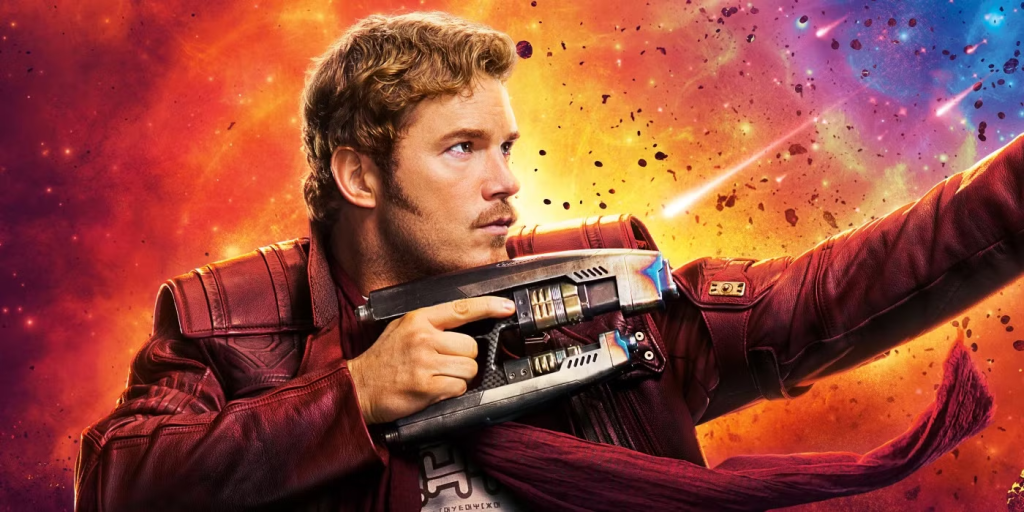
There’s no one out there who would describe Star Lord as being the most serious and stoic hero in the MCU. He’s a dork of the highest order. I mean, this is the guy who saved the galaxy by having a dance-off with a galactic warlord. Star Lord’s whole thing is being quippy and jokey in just about every single circumstance, and thus he’s written in that way in almost every single one of his scenes. Almost every single one.
If there’s one thing Star Lord never jokes about, it’s his mother. So, when he hears directly from the mouth of his estranged father that he was the reason Star Lord’s mother died? All the jokes and quips are gone. No more smiling, this is serious business. You could hear a pin drop with how all of the fun is sucked out of the room as the realization dawns on Star Lord and deeply triggers his anger. It’s about as opposite as his normal characterization can get.
But is that a bad thing? No, not at all! It’s a perfectly reasonable response upon hearing such a bombshell confession as that, for basically any human being, I’d wager. But particularly for Star Lord, we the audience have seen time and time again that even with his quips and jokes, he dearly loved his mother and laments her passing. Even if his happy-go-lucky nature is his primary characteristic, he has layers beyond that, which have been well established thanks to the quality of the writing. This sudden pivot in behavior doesn’t feel wrong at all, it feels both justifiable and warranted.
So that’s what I’m not trying to say about character consistency. So what am I trying to say? I’m trying to say that writing consistent characters is one of the most important aspects in all of storytelling, if not the most important thing. Without consistent characters, your audience has absolutely nothing to latch onto. It’ll be an insurmountable challenge for them to enjoy your story when it feels like everything is just changing on a whim.
But there is a catch to consider here, and it ties a bit back into our discussion on redemption from last week. In that article, I mentioned how some members of your audience simply will not be able to agree to a redemption arc if they feel that the character has done too much evil. The emotional core of this idea, I think, can be traced back to character consistency. There’s a certain threshold where your audience will simply refuse to believe that a character is still the same person when their journey of growth has morphed their characterization to such a point that they become unrecognizable. It doesn’t matter how theoretically good your writing of their character journey has been, your audience will refute their consistency on an emotional level.
Why? Well, I feel that it has to do with first impressions.
In our world, it’s often said how important first impressions are. That’s why we dress our best for interviews and dates, bring as much energy as we can to auditions and meetings, and meticulously prepare (and maybe stress) over important events. Just like in the world of writing, no matter how much work you put in to better yourself, it can be extremely hard to overcome someone’s perception of you that they gained from a first impression.
Unfair? Yeah. Realistic? Unfortunately.
First impressions are just as important in the world of writing.
To further analyze this (and full transparency here, half the reason I wrote both this article and last week’s was to talk about this character), I’m going to explain to you the fallacy of Topaz from Honkai Star Rail.

Who is Topaz? Topaz is a proud member of the Interastral Peace Corporation, or IPC. They’re basically the space government, and Topaz herself is essentially a space IRS employee. She’s a charismatic and confident woman who doesn’t let anything get in her way, but is always willing to help out an ally in need. She interacts with your main character and other allies on multiple occasions, providing assistant while she can. A bit cunning, but not overtly evil or anything.
There’s just one problem with this. Everything I just described to you is from events and side quests that take place after your initial encounter with Topaz. In her first encounter, Topaz is…well, let’s just say that ‘different‘ is putting it mildly.
Your first ever time meeting Topaz comes right after you liberate the small planet of Jarillo VI from a planet-destroying threat. You befriend a group of determined resistance fighters and defeat a corrupt ruler and a cosmic entity, saving the planet from annihilation! Hooray! Trouble is, in doing so you reconnect Jarillo VI to the rest of the galaxy, including the IPC (who had thought the planet was wiped from existence). The IPC then comes calling, as it turns out that Jarillo VI took out an IPC loan seven-hundred years ago, and the IPC still plans on collecting, no matter the cost.
Topaz leads the charge, and to say that she’s fanatically devoted to the IPC is putting it mildly. The IPC ‘saved‘ her own home planet when she was a child (by essentially forcing all citizens into its workforce against their will), so Topaz has felt indebted to them ever since. As such, she’s here on Jarillo VI to do the exact same thing. Her proposal on how to settle the debt Jarillo VI owes the IPC? Simply conscript all citizens of the planet into serving the IPC for all time, and terraform the planet using an experimental device so that the planet produces more profitable minerals.
Suddenly, those traits I mentioned about Topaz above take on a much more un-palatable bent. Her charisma manifests as condescension (she belittles the chances of Jarillo VI ever paying off their debt naturally), her confidence turns into lack of empathy (she has no problems extorting a planet that only just managed to pull itself back from a crisis), and her cunning nature is more akin to cruel manipulation (she neglects to mention that the terraforming device has only a 62% chance of working, and a 38% chance of rendering the planet inhospitable).
And when you confront Topaz about this? Well, first she discreetly sends some of her soldiers to attack the citizens, all so she can then claim ‘oh, I’m sorry, they are acting out of order, see I’m on your side‘. Then she uses a computer virus to sabotage all robotic components on the planet to cause further chaos. Then, when cornered, she just straight up tries to kill you and your allies so that there’s no one strong enough left behind to contest the planet. The only reason you survive and stop her scheme is that you end up discovering an ancient forge buried deep underground, that has enough potential for engineering that it could eventually pay off the debt.

In case you’re still confused, these are the actions of an abject villain. A rather good one, I might add! Topaz is extremely hateable, which is a credit to how well she’s written. The trouble comes when Topaz starts appearing elsewhere in the game, and the game expects you to view her as some sort of friend, or even ally. I’m sorry, where is this coming from? You can make the argument Topaz was just trying to do her job, but the woman certainly didn’t do herself any favors by how callously she acts all the time! I can’t view her as a friend at all, because her first impression as a villain was so strong there’s nothing the game can do to make me buy that she’s not just evil, especially as it’s not as if she has a character arc or anything to explain her changes.
Do you see what I mean about first impressions? In Honkai Star Rail the developers accidentally made Topaz’s first impression as a villain too strong, to the point where I just can’t see her as anything else now. It’s the same with any story. If you make the mistake of not handling your first impression scene correctly, whatever your reader first sees of your character is now all that they are going to think of them as. If that first impression is the characterization you intended…awesome! It it isn’t…you’re in trouble.
But, hold your horses, because we’ve got yet another angle to add to the mix! What about characters whose first impression isn’t a real first impression? Uh oh!
What does this mean? With this I’m referring to when a character has a strong and defining first impression, but we then later see that that first impression wasn’t all it was cracked up to be. Perhaps the character was putting on a performance, or actively lying, or trying to make themselves appear different? Maybe we the audience just saw them in a certain light, but in reality the truth is more enlightening. Think of Trinity from The Matrix who can somewhat look like a villain (or at least morally ambiguous) during the opening scene since she is running from and attacking police officers, but we later learn the truth of who she is and what she’s fighting for.
To examine this further, let’s look into one of my favorite video games from my childhood, Super Paper Mario, and specifically that game’s central antagonist, Count Bleck.
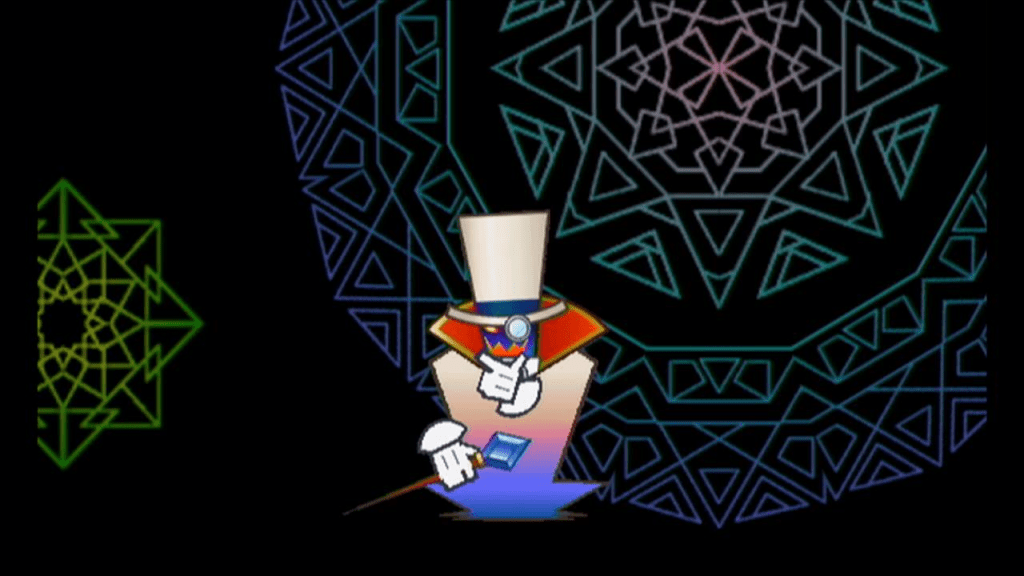
Count Bleck’s first appearance (and thus where he makes his first impression) is when he sabotages a normal day in the Mushroom Kingdom by kidnapping Peach and trying to force her to marry Bowser, blasting away a bunch of innocent citizens, and teleporting Mario into a different dimension. Some pretty typical bad guy stuff, and not too out of the ordinary for a Mario game. Obviously, Count Bleck is not a chill dude, and we’ve gotta stop him to save the world.
Except, what is he doing the next time we see him? He’s hanging out at his castle, conversing with his loyal minions who he treats more like family than subjects he can boss around. He’s pretty gentle with giving orders, he tolerates the eccentricities of his followers, and he isn’t above joking around with them a bit. He’s quick to forgive failure, and he often places the safety of his followers over his own. He’s a fantastic boss, and an all-around good guy to those who work for him. The player starts to realize that, actually, even when he’s doing evil acts like in the prologue, he’s still pretty civil, courteous, and well-mannered.
And that’s not even to get into the rapid expansion of character development he undergoes as we learn more about his tragic backstory.
More point is, players almost immediately realize that this man isn’t some one-dimensional baddie, nor is he really as evil as he purports. They recognize that their first impression, their initial snap-judgement, was a bit wrong, and that they need to reorient their thinking.
This sort of fake-out first impression tactic can be really hard to pull off. If your first impression of a character is so strong, it can be hard to shake it even when confronted with what the author intended to be the real first impression. Or, if the fake first impression and the real first impression are so diametrically opposed, it can boggle the reader’s mind and keep them from reconciling and accepting the difference. Use this tactic with caution, I’d say.
All of this is to say that it’s a constant battle to be careful with character consistency and first impressions. Fumbling the consistency of your characters is one of the easiest ways to lose your reader’s care and focus (tied perhaps with overly convoluted plotting, which is maybe worth discussing in a future article), whereas maintaining strong consistency, clever writing, and intricately intentional character crafting is a surefire way to make your story unforgettable.
Keep on writing, friends!
 The Contrarian Corner