

It’s not often that a video game comes out of absolutely nowhere and yet manages to rustle up enough exposure to take over the entire gaming world. And yet, that’s exactly what Clair Obscur Expedition 33 (hereafter just Clair Obscur) managed to do when it released a few weeks back. I’m sure some people were following its development, but the vast majority of people had no idea what this game was when it released, and yet now it’s one of the highest rated video games of all time, and in contention for winning Game Of The Year at this winter’s big gaming awards show.
I you asked my personally if it should win, I don’t know if I’d say ‘yes‘ though…as you may have guessed from the title of this article.
Rest assured, though, that Clair Obscur is still a really good game. So before I get bogged down in the weeds of my complaints towards the game (of which I do have quite a bit to say), let’s start things off more positively by talking about what I did really like!
But before that, a quick aside on what Clair Obscur is even about:
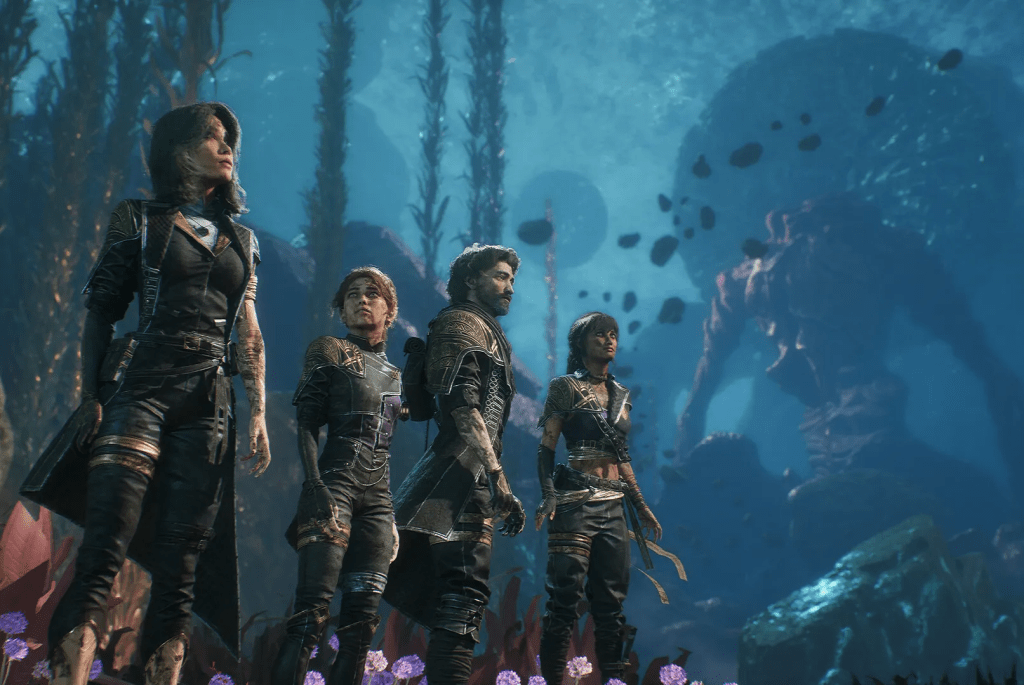
Clair Obscur is the story of a girl named Maelle, told from the perspectives of her friends and allies that help her on her journey. In this fantasy-ified version of our own world, France got blown into bits because of some big magical event, and the remnants of humanity hunker down in a chunk of the city they’ve named Lumiere. Across the sea is the rest of the world, consumed by magic and malicious creatures called Nevrons. Worst of all, these creatures are seemingly commanded by a woman named the Paintress, who each year draws a number on a big monolith, starting at 99 and counting down by 1 each year.
Every year when she passes over a number…anyone who is that age dies.
And so the citizens of Lumiere begin the tradition of yearly expeditions to the mainland to confront the Paintress and her Nevrons, and stop her from drawing these numbers and claiming all of these innocent lives. There’s a real sense of urgency and stakes in the story, and many of the themes cover loss, time, pain, and grief. It’s pretty riveting stuff, and you quickly become attached to Maelle and her companions, like her brother Gustave, and fellow expeditioner allies Lune and Sciel.
Anyway, moving onto the big positives, and first off, the combat mechanics are immaculate!
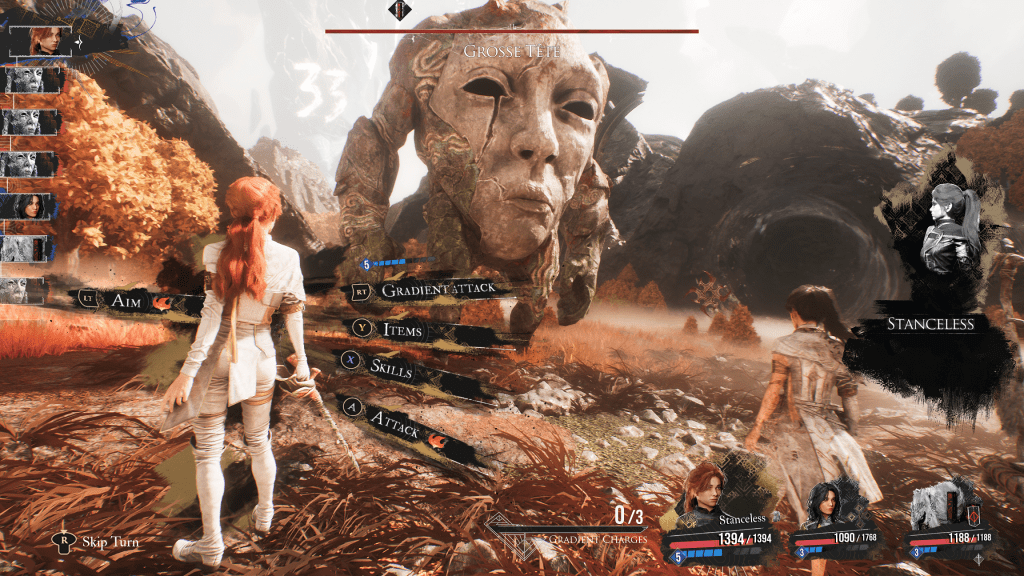
Clair Obscur is a turn-based RPG, which is nothing new. However, two tiny little tweaks shake up the entire formula. The first is Free Aim, which allows you to fire magic bullets at the enemy AND it doesn’t count as your attack for the turn (though it does use up your in-battle stamina, your AP). You control the cursor of where you want to Free Aim (hence the name), allowing you to choose which enemy to shoot and also where on their body to hit them. Many enemies have special weakpoints that give big bonus damage or other boons for taking them out. It’s fun!
Secondly, you are able to control your character on the enemy turn, allowing you to dodge, parry, or even jump over enemy attacks! I’ve never loved how unavoidable it is to take damage in a turn-based RPG, and that becomes a non-issue in Clair Obscur. Just practice your timing (playing lots of Soulslike games helps), and you can beat the entire game without getting hurt. Plus, if you perfectly parry an enemy, you can even launch a damaging counterattack!
Now, this level of active participation does mean the Clair Obscur falls on the harder side of many RPG experiences, but the difficulty modes in the game do allow for players of all skill levels to give the game a try.
The Pictos-Lumina system is also amazing, and shockingly player-friendly. Pictos act as equipment, but alongside providing stats they also give a passive buff (something like “Deal 20% more damage to enemies who are Burned“). If someone equips a Pictos and fights four battles in a row, they unlock that Pictos’ respective Lumina, which is just the same passive but freely equippable…by everyone in the party! Only one character needs to unlock the Lumina for a Pictos, and then everyone can enjoy it! That’s so nice, and amazing, and time-saving, and it’s something many lesser RPGs would get wrong!
And because it’s a breeze to unlock Lumina passives, you’re actively incentivized to pursue insane customization and team-building options. It’s pretty heavy micro-management, which might not be everyone’s cup of tea, but I found it pretty thrilling to create a bigger and better team with each new Lumina. If you really stretch your brain muscles, you can create combos and character builds that are so broken that you become invincible, or even end up one-shotting every single enemy in the game (including the otherwise tough-as-nails superbosses). It’s a blast.
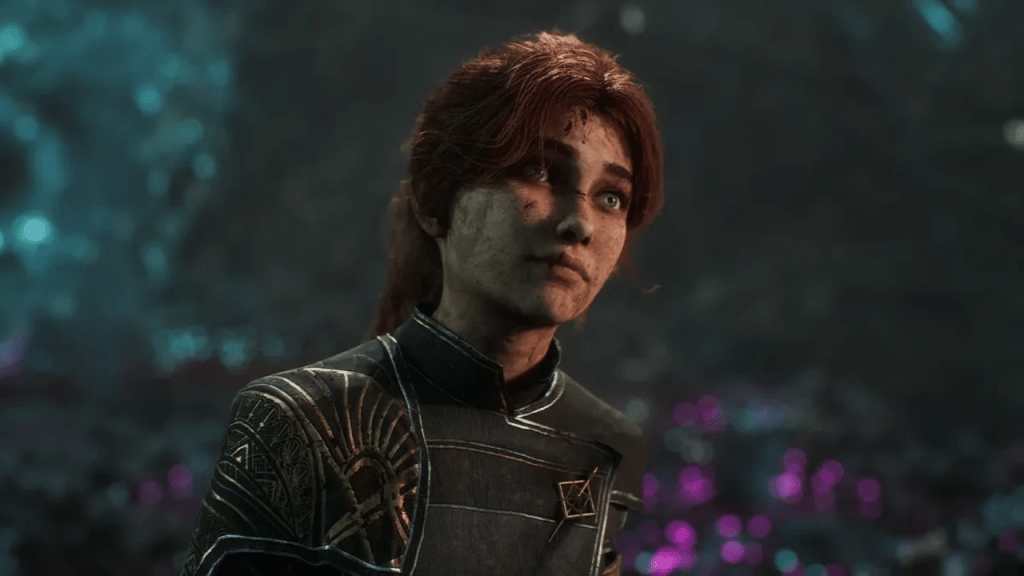
I also have to give a shoutout exclusively to Maelle, the game’s central protagonist and one of your core party members. As a character, she’s wonderfully written, and remains engaging and emotionally tied to the core narrative and themes for the entire game. And as a party member? She genuinely might be the single most broken character from any RPG that I’ve ever played in my entire life, and I adore that about her. Watching her dash around with finesse, one-shotting every thing that breathes in a five mile radius of her was a joy from start-to-finish.
And then there’s the technical aspects, like the visuals and sound design. The game is very pretty (most of the time, some textures are iffy, and there’s a fair bit of pop-in on the overworld), and the environments are detailed and memorable. The soundtrack is phenomenal in every possible way, and will most-likely deservedly win Soundtrack of the Year. The voice acting is also top-notch, with both big names (Charlie Cox, Andy Serkis, and Jennifer English), and fresh faces bringing together one of the best ensemble performances in the past decade of gaming.
Whew…lot of positives, right? Well, now we transition into the story elements of the game, and that’s where things start falling apart. I’ve got four big issues in total, and I’ll cover them from smallest to biggest.
(Big spoilers from this point on, folks!)
First is the game’s tone. It’s a mess.
This is a dark game, with plenty of emotionally heavy moments, violence, and death. The themes of the game weigh on you. Now, of course, this doesn’t mean it needs to be 100% dreary for its entire runtime. Plenty of darker stories have room for a little bit of levity mixed in with all of the doom-and-gloom. Alfred has some funny quips in The Dark Knight, and there’s a few silly visual gags in RWBY‘s darkest season, Volume 8.
However, Clair Obscur continuously fails to get this balance right. Like, it does a really poor job at it.
At the end of the prologue is an extremely touching scene of a character you knew was going to die dying (her age number was about to be erased by the Paintress’ yearly actions). Soon after, almost all of your expedition team is slaughtered brutally mere minutes into their attempted journey to the continent to confront the Paintress. A little bit after that, the POV character you play as, Gustave (remember that while Maelle is the main character, you view her story through the eyes of others) considers ending his own life in a really soul-crushing scene, surrounded by the bodies of his comrades.
This is the sort of thing that sticks with you for a long time, just one emotionally punch after the next. And yet, only an hour or two later in the game, you meet a little wooden doll guy named Noco who speaks in half-gibberish and half-French and makes silly jokes. A little bit after that you meet the rest of his brethren, who are even more dumb (some of them make straight-up references to internet memes). Then you have to settle a dispute between a goofy inflatable-looking man and a angry British rock who bicker like an old married couple, all while Gustave stares directly at the camera in disbelief in a scene right out of The Office.
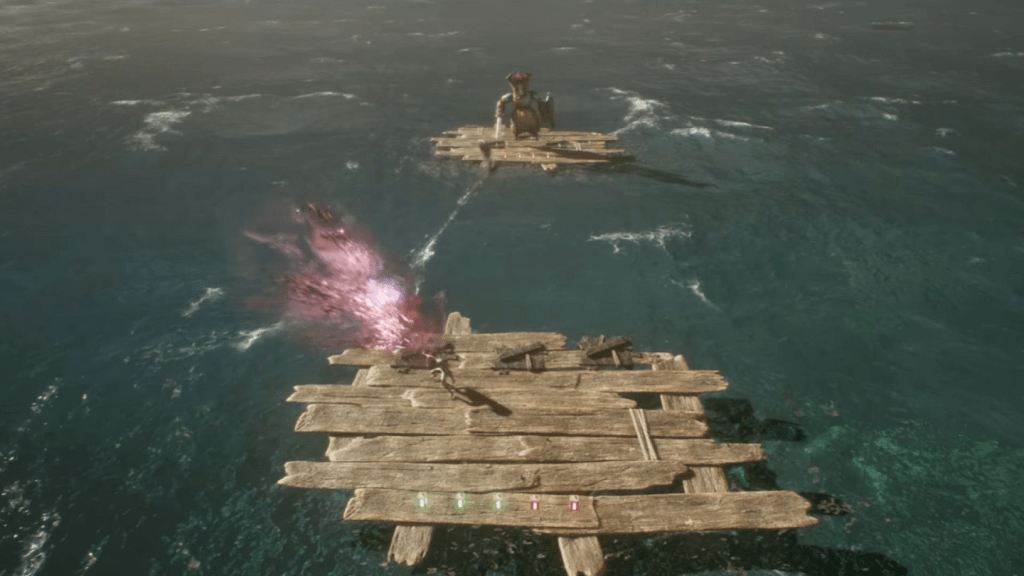
And don’t even get me started on the Gestral Beach minigames, which include obstacle courses and games of volleyball, reward your party members with swimsuit outfits, and are backed-up by a soundtrack of tropical jazz!
Like…excuse me? What the heck is happening?
There’s a difference between a little joke here-or-there to ease the tension, and complete immersion-destroying tone-deaf scenes and behaviors. How am I supposed to take this game’s story seriously when even it doesn’t seem to be taking itself seriously? Like, occasionally it gets the tone right with a good quip from Monoco, and then in the next scene someone brutally is murdered, and then right after that Esquie is laughing and saying “time for a swimmy swim-swim“! It’s absurd.
Second is the game’s central themes, in relation to the game’s length.
For starters, let me point something out: this game’s plot and themes are SHOCKINGLY similar to Xenoblade Chronicles 3. Like, it’s crazy how similar they are. A doomed world trapped in a constant cycle of death and fighting. Brave young heroes who set out to try and change their lives, but they have this figurative-guillotine of a time limit hanging over their heads. Prevalent themes of time and loss, how hard you’d fight for more time, how you should spend the time of your life if you know its running out…that sort of thing. Not saying this game copied XC3 or anything, of course.
The thing is, XC3 is a 100+ hour game, while Clair Obscur is closer to 30 hours. And while there’s plenty of short games that fully capture their themes and plot (looking at you, What Remains of Edith Finch), the simple truth is that the more heavy and complex your story is, the more time you need for it to simmer and mature. Clair Obscur, fundamentally, doesn’t give itself enough time for these things to work out, especially given how break-neck the pace is (like, if you skip the optional side content (of which there is a bunch in this game), you could probably beat it in closer to 20 hours).
To make matters worse, Clair Obscur shifts its entire theming at the halfway point, and the game changes from being about time and sacrifice to being about grief, and the idea of what the proper way to grieve is, and asking its characters and players the question of if they’d willingly stay in a happy moment forever instead of facing trauma head-on. A great theme to tackle, to be sure…but now there’s even less time to fully flesh it out, and what’s worse is that the game’s initial themes get practically abandoned during this thematic pivot!
And you know what else is crazy? XC3 does literally this exact same theme shift, only 1000 times better! Again, that game’s longer length allows for these moments to really be fleshed-out, and also the shift to focusing on grief and holding onto one moment forever much more naturally aligns with the themes in the first half of that game, creating a much more cohesive whole than in present in Clair Obscur.
My third big story complaint is the Act One finale, which results in the death of Gustave.
Up until this point, you the player have been playing exclusively as Gustave, witnessing Maelle’s journey through his eyes. He’s a great character (with a great performance by Charlie Cox), and he’s charmingly awkward while still being a good leader. And I’m totally okay with the fact that he dies. I think the death of a protagonist in a story like this can be a really good twist, one that motivates and drives character growth in the remaining heroes, plays into the themes of the narrative, and establishes a critical threat from the villains.
The trouble is how little the game does with this pivotal moment, to the point where I genuinely consider it to be a pretty wasted moment.
There’s the same issues with tone as I mentioned earlier. Minutes after Gustave dies and you’re getting bombarded by Esquie and his goofy voice and mannerisms, and a dumb Gestral Beach volleyball minigame. Gameplay-wise, it doesn’t work either. You gain a new character named Verso after Gustave’s death (and your player POV switches to Verso too), and while he plays differently than Gustave, his skils do much the same thing. Heck, he even joins your aprty at the same level as Gustave, with all the same gear as Gustave, and he uses the same weapons as Gustave. It’s like the game itself is trying to tell you “yeah, whatever, Gustave died, just use this new guy instead“.
And then Gustave’s death felt severely lacking in terms of story impact too. Outside of Maelle (who has great character growth in the wake of her older brother’s death), no one else really seems to grow or change much. Yes, I get it. Lune likes to keep her feelings locked away, and Sciel likes to hide her feelings with a façade of nonchalance. But it still almost feels cold how little they seem to change after Gustave passes. What’s worse is that the theme shift happens around this time, and since we move away from time and sacrifice and over towards grief, Gustave’s last-stand (dying to save Maelle) falls to the wayside for everyone but Maelle herself. It’s such a strange moment in the story that feels wholly unearned.

Fourth and final is the game’s ending, which is just a letdown in almost every way.
See, there’s a late-game twist that reveals that the entire world you’ve been exploring actually exists within a magical canvas created by a family of magically-powered painters living in the real world. Maelle and Verso both exist in the real world, except Verso actually died, so the only Verso left is the one in the painting who is actually just a recreation. Every other one of your party members are painted creations too. It’ll take me longer to explain every little detail, so I’m just mentioning the important bits.
The end-of-game choice thus becomes whether you side with Maelle, who wants to stay inside the canvas forever alongside Verso and her other friends, or if you want to side with Verso, who desires for her to go back to the real world and face her trauma head-on and grow from it. A fairly standard choice, and one that would incline me to side with Verso. I think that’s just a common way that the theme of grief plays out in stories like this. It can be comforting to stay where you’re happy and run from sadness, but it will hurt you in the long-run to not face your trauma and heal from it.
Here’s the issue, though. Just because this painted world isn’t the real world, doesn’t mean it isn’t still REAL. All of your party members, the other humans living in Lumiere, the silly Gestrals, and even the Nevrons? They are all living sentient creatures breathed into life by Maelle and her family in the real world. They aren’t programmed robots, or characters from a storybook come to life but stuck following their creator’s orders. They are sentient, sapient beings able to make their own choices, possessing their own free will, and desiring to live their own lives.
And if you side with Verso, and Maelle leaves the painted world? They, and the entire painted world, all die.
The ending choice then shifts from being a choice about running from grief or facing it, and instead becomes an ethical headache. Because, in reality, your two options are as follows:
A) Maelle stays in the painting, and all the beings she created get to keep living happy lives, at the cost of her own health/sanity.
B) Maelle leaves the painting to get some much-needed therapy, and thousands upon thousands of living creatures die for her sake.
I’m sorry, but Option A feels like the only viable option! I care deeply about Maelle as a character, but not at the expense of thousands of innocent lives! Innocent lives she helped to make! It’d be like if Jurassic Park ended with John Hammond nuking the island to kill all the dinosaurs! He helped bring them into the world, it’s his responsibility now to take care of them and make sure they can keep on living! If Maelle chooses to leave, she’s choosing selfishness and, basically, genocide.
The real kicker here, and what really ruins this ending, is that it’s so painfully obvious that the developers of Clair Obscur didn’t even consider this (how they failed to do so, I have no idea). The game makes it obvious that it wants you to side with Verso, and it goes to great pains to guilt-trip you if you side with Maelle, by making it clear that she’s deteriorating by staying within the painting. Clair Obscur so desperately wants this final choice to be about how grief should be processed, and yet it fumbles it horribly by constructing a world in such a manner that it turns this poignant moment into an ethical nightmare that it is supremely ill-equipped to handle.
The developers were extremely out of their depth with this ending, and it really caps off the game on a sour note.
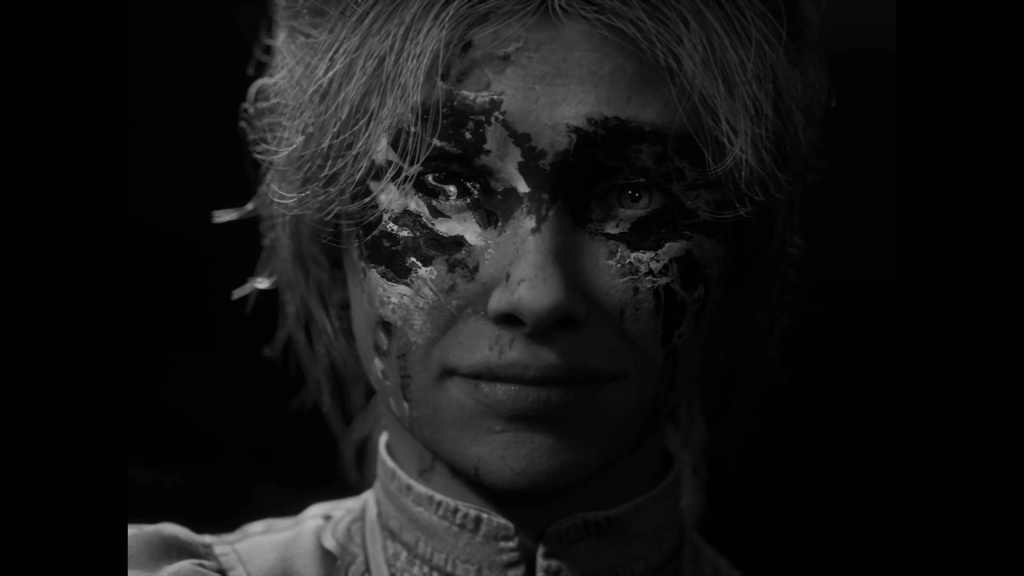
But hey, even with all that aside…it’s still a good game. So-so story, but excellent gameplay. I said it at the beginning of the article, that while Clair Obscur wouldn’t be my pick for Game of the Year, it’s still really good and very fun. I stand by that, and would wholeheartedly recommend it to any RPG fans out there!
8/10
 The Contrarian Corner